

In Singapore’s tightly structured business environment, transport planning is no longer treated as a standalone service arranged only when needed. Instead, transport and logistics planning is embedded into the daily movement of employees, students, and operational teams, forming a routine part of corporate execution rather than an occasional administrative task.
Daily workforce movement, including morning arrivals, end-of-day dismissals, and shift transitions, is increasingly dependent on coordinated transport arrangements. For factories operating multiple shifts, offices running fixed reporting hours, and schools requiring punctual student transport, consistency is not optional. Movement must occur on schedule, at scale, and without disruption.
Ongoing staff and institutional transport commitments shape cost patterns across financial periods. When transport is arranged daily or weekly, it becomes a predictable operational line item that influences budgeting cycles, vendor contracts, and long-term cost allocation decisions. Over time, even minor inefficiencies in planning can accumulate into a measurable financial impact. For example, repeated late departures that require extended standby time or additional vehicle deployment can gradually increase monthly transport expenditure.
Operational predictability is directly influenced by the timing, frequency, and consistency of transport arrangements. Late arrivals, vehicle shortages, or last-minute coordination issues not only affect passengers. They can delay production schedules, disrupt meetings, or create compliance concerns in regulated industries. In shift-based environments, even a 15-minute delay can affect production turnover and overtime allocation.
As companies in Singapore face increasing scrutiny over operational expenditure, transport decisions are being examined as part of broader cost and efficiency management strategies. Procurement and operations teams now evaluate transport not just by price, but by reliability, contingency planning, and service consistency.
Common corporate use cases in Singapore include factory shift transport, office shuttle services, scheduled school-related transport that requires disciplined daily execution, and certain forms of medical transportation services where timing reliability is essential. These arrangements must operate with minimal variance, especially during peak traffic hours and high-demand periods, as delays can affect production schedules, institutional timetables, or time-sensitive appointments. Event-based transport such as weddings and funerals also requires strict timing control, as guest arrival windows and venue access periods are often fixed and limited.
As a result, transport planning is increasingly assessed based on execution reliability rather than theoretical efficiency. The ability to deliver consistent, punctual service across months or years has become a defining factor in determining whether a transport arrangement supports or undermines operational stability.
Key Takeaways
- Recurring workforce and institutional transport arrangements directly influence long-term cost patterns, making structured planning essential for financial predictability.
- Scheduling discipline and appropriate fleet allocation reduce operational disruptions and minimise cumulative expenditure over time.
- In Singapore’s tightly regulated and time-sensitive environment, punctual execution and response readiness are critical to maintaining production flow and organisational stability.
- Governance-led transport planning, supported by clear accountability and defined escalation processes, strengthens reliability and supports sustainable operational performance.
How Transport And Logistics Planning Drives Cost Control And Operational Continuity

How Cost Predictability Is Shaped By Recurring Transport Execution
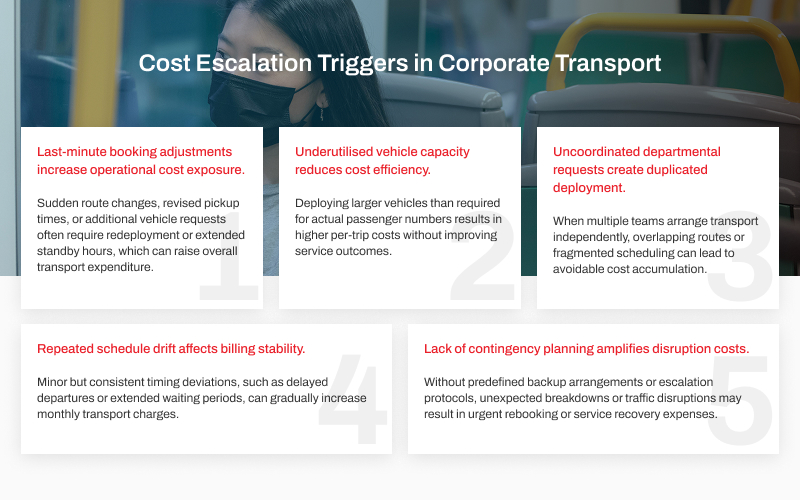
In Singapore’s corporate environment, transport and logistics decisions influence cost structures in ways that are often gradual but cumulative. Unlike one-off journeys, recurring corporate deployment forms the backbone of long-term expenditure, making planning discipline central to financial control.
Cost patterns are formed through scheduled corporate transport that operates daily or weekly under fixed service windows. In structured environments such as factories and offices, this recurring execution shapes baseline operating costs over time. When routes are repeated consistently, finance teams can integrate transport and logistics commitments into predictable budget cycles.
Transport expenditure accumulates through repeated deployment rather than isolated trips. For example, fixed daily routes supporting shift workers or office staff contribute directly to predictable monthly spend. Over time, long-term service agreements create measurable cost patterns that support forecasting accuracy and contract planning stability within broader transport and logistics frameworks.
Fleet allocation and service continuity also influence long-term expenditure stability. When vehicle sizes match actual headcount, organisations achieve stronger corporate transport utilisation, reducing unnecessary capacity costs while maintaining reliability. Conversely, deploying oversized buses for small groups over extended periods can increase cost exposure without improving service outcomes.
Structured scheduling supports stronger transport scheduling efficiency, allowing procurement teams to evaluate whether deployment frequency, route design, and passenger volume align with operational needs. By contrast, fragmented arrangements weaken cost clarity.
Repeated timing misalignment, such as inconsistent pickup windows or fluctuating departure times, can gradually increase cumulative expenditure. Last-minute changes and ad hoc requests often require redeployment or urgent reallocation of vehicles, exposing organisations to higher rates and administrative strain. In the context of transport and logistics planning, these small deviations compound across billing cycles.
Inconsistent deployment may also lead to inefficient resource use, under-filled buses, or billing disputes. Without a defined scheduling discipline, cost predictability in transport operations becomes harder to achieve, particularly when multiple departments coordinate bookings independently.
When planning is consistent, transport costs appear as stable operational line items. This strengthens logistics cost planning by reducing ambiguity during procurement reviews and financial audits. Clear schedules enable providers to commit to defined fleet availability, improving transparency in transport and logistics cost structures.
Greater cost visibility improves coordination between procurement, finance, and operations teams. With structured agreements in place, there is a lower incidence of unplanned adjustments, and transport and logistics expenditure can be reviewed based on performance data rather than reactive escalation.
How Planning-Led Transport Arrangements Support Operational Continuity
Operational continuity depends on whether workforce movement aligns precisely with institutional schedules. In Singapore, workforce arrival and dismissal typically follow predictable sequences tied to fixed reporting hours and shift transitions. Well-structured transport and logistics arrangements ensure these movements occur without congestion or delay.
Disruptions tend to emerge when transport timing diverges from real operating schedules. Factory shift handovers, for instance, rely on fixed bus arrival windows and consistent dispatch times. Even minor inconsistencies can delay production lines or extend overtime costs, reinforcing the operational role of transport and logistics planning.
Vehicle deployment must reflect actual passenger demand. Under-utilisation leads to unnecessary cost inefficiencies, while over-extension places pressure on service reliability. Flexible deployment of 13-seater and 23-seater buses enables right-sized arrangements that balance capacity with demand. Strong demand for 13-seater minibuses in Singapore reflects the need for adaptable fleet sizing within structured transport and logistics operations.
Fleet adaptability becomes particularly important when headcount fluctuates. Temporary projects, contract staff, or seasonal peaks require scalable arrangements. Proper operational transport planning ensures that fleet adjustments are executed without disrupting daily schedules.
Predictable arrangements also reduce the volume of reactive communication. When routes, timings, and contingency plans are clearly defined, operations teams spend less time coordinating last-minute changes. This strengthens administrative efficiency within overall transport and logistics execution.
Clear escalation pathways and backup deployment protocols further support continuity. When alternative vehicles are available and response procedures are pre-established, recovery time is shortened, and downtime is minimised. Such planning reinforces reliability within structured transport and logistics systems.
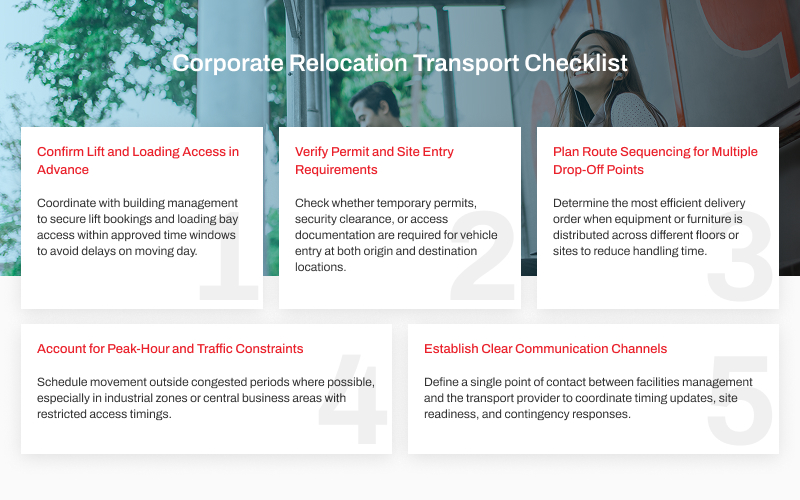
For furniture moving and corporate relocation projects, planning becomes equally critical. Coordinating loading windows, lift access timing, manpower deployment, and route sequencing ensures that business operations are not interrupted during office moves or equipment transfers. Structured movement planning prevents bottlenecks and reduces downtime during relocation periods.
What Singapore-Specific Conditions Mean for Transport Planning
Singapore’s dense urban environment combines short travel distances with high traffic variability. Peak movement periods frequently coincide with school reporting times and industrial shift changes, creating compressed travel windows. Effective transport and logistics planning must therefore account for real traffic conditions rather than nominal route durations.
Higher sensitivity to delays during early morning and late evening operating hours increases operational risk. Minor timing deviations can create amplified downstream effects, particularly when schedules are tightly synchronised across departments.
Across sectors such as schools, factories, and offices, daily timetables are typically rigid. Transport availability can either reinforce or disrupt operational flow. When schedules are misaligned, punctuality and internal coordination suffer, affecting productivity and staff morale.
In corporate and institutional settings, service expectations extend beyond punctuality. Cleanliness standards, driver professionalism, and accountability influence long-term provider relationships. Reliable transport and logistics arrangements contribute to organisational reputation and staff satisfaction, particularly when transporting employees or students daily.
As scrutiny on pricing increases, decision-makers also evaluate transparency. Understanding Singapore bus charter rates within the context of recurring deployment helps procurement teams compare structured contracts against ad hoc booking models. Clear pricing frameworks reduce disputes and strengthen trust in transport and logistics partnerships.
Ultimately, long-term efficiency emerges from consistency and disciplined execution rather than short-term savings. In Singapore’s high-accountability environment, transport and logistics planning that prioritises reliability, structured scheduling, and transparent cost alignment supports both operational continuity and sustainable expenditure control.
Transport Planning Within Corporate Decision-Making and Governance Frameworks
Why Transport Planning Forms Part Of Corporate Decision-Making Processes
In established organisations, transport and logistics decisions do not sit within a single department. They intersect finance, operations, HR, and facilities functions, particularly when recurring staff movement or institutional schedules are involved. As a result, transport planning becomes part of structured decision-making rather than a transactional purchase.
When movement involves daily workforce deployment, planning clarity supports defined ownership across departments. Finance teams assess budget impact, operations teams evaluate execution feasibility, HR considers staff welfare, and facilities oversee on-site coordination. Within this framework, transport arrangements are increasingly evaluated based on execution reliability, response capability, and alignment with broader operational objectives.
Legendary Transport works closely with operations managers, procurement teams, and school administrators to align route planning with internal reporting structures and approval workflows. Instead of treating each booking as an isolated request, planning discussions typically begin with headcount projections, operating hours, pickup sequencing, and contingency requirements. This ensures that transport arrangements integrate smoothly into daily operational frameworks.
This approach is particularly relevant where transport for employees form part of routine workforce deployment. By establishing defined schedules, committed fleet allocation, and contingency readiness in advance, organisations reduce administrative friction and strengthen accountability across departments.
How Governance Expectations Shape Recurring Corporate Transport Arrangements
In recurring corporate engagements, governance expectations extend beyond punctual arrivals. Structured transport arrangements must demonstrate consistent service standards across contract periods, particularly where long-term school, factory, or office transport services are involved.
Clear escalation pathways reduce uncertainty when disruptions occur. Rather than relying on reactive troubleshooting, governance frameworks favour response readiness, defined communication channels, and documented contingency procedures.
Legendary Transport maintains documented response protocols and standby arrangements to manage unexpected vehicle issues, heavy traffic disruption, or last-minute route adjustments. This structured readiness reduces reliance on reactive coordination and shortens recovery time.
Governance frameworks also reinforce accountability on both sides. Clients commit to defined schedules and passenger volumes, while the provider commits to fleet availability, service standards, and communication protocols. Within such arrangements, transport and logistics planning supports operational discipline that extends beyond individual journeys.
How Service Execution Standards Reflect Governance Outcomes
Service execution standards directly influence how corporate transport arrangements are perceived internally. Driver professionalism shapes daily operational experience, especially when transporting employees or students on fixed schedules.
Vehicle cleanliness contributes to workforce satisfaction and reflects organisational standards, particularly in institutional settings where repeated exposure to the same vehicles builds familiarity. Consistency in service delivery reinforces trust over time, strengthening long-term working relationships.
Legendary Transport applies defined cleanliness checks, trained drivers, and fleet readiness protocols as part of its day-to-day execution standards. These operational practices support reliability within recurring service commitments and demonstrate how governance expectations translate into measurable service outcomes.
Daily fleet inspections, scheduled maintenance checks, and driver briefing procedures form part of routine operational practice. These practices are designed to maintain cleanliness, punctuality, and service consistency across recurring contracts.
Sustained operational discipline not only reduces service escalation but also supports long-term client retention, particularly in environments where reliability, accountability, and execution consistency are essential.
Frequently Asked Questions
1. How Does Transport Planning Influence Cost Control For Recurring Corporate Transport?
Transport planning influences cost control by stabilising schedules, routes, and fleet deployment over time. When transport execution follows defined patterns, organisations experience fewer cost escalations and clearer visibility over ongoing transport expenditure, supporting budget forecasting and procurement planning.
2. Why Is Planning More Critical For Shift-Based And Scheduled Transport?
Shift-based and scheduled transport amplifies the impact of planning decisions because services are repeated daily. Inefficiencies compound over time, while consistent execution reduces delays, coordination issues, and administrative escalation.
3. How Does Fleet Flexibility Affect Operational Continuity?
Fleet flexibility allows transport providers to match vehicle size to passenger demand, supporting continuity when group sizes change, new routes are introduced, or schedules adjust unexpectedly.
4. What Role Does Response Readiness Play In Transport Planning?
Response readiness limits operational disruption when issues occur. Backup vehicles, trained standby drivers, and defined escalation processes reduce downtime and restore service continuity more quickly.
5. How Do Service Standards Influence Long-Term Transport Reliability?
Service standards such as driver professionalism and vehicle cleanliness contribute to consistent user experience and operational confidence over time, reinforcing trust and long-term partnership stability.
Conclusion
Predictable transport and logistics execution supports both cost control and operational continuity in corporate environments. When planning reflects real-world operating schedules, appropriate fleet allocation, and defined response procedures, organisations experience fewer disruptions and stronger oversight of recurring expenditure.
In Singapore’s tightly regulated business landscape, recurring workforce and institutional transport require more than basic coordination alone. It demands disciplined scheduling, aligned capacity planning, and clearly defined accountability across departments.
For organisations managing daily staff deployment, school transport commitments, or scheduled event movement, Legendary Transport aligns planning processes with fleet readiness and execution standards to support stable operations.
If your organisation is reviewing its recurring transport arrangements, consider speaking with Legendary Transport Management to evaluate how structured planning and disciplined execution can support long-term operational stability.




 Legendary Transport Pte Ltd